
Introduction: Welcome to the Post-Digital Era
The digital revolution is no longer the competitive advantage — it is the baseline.
Every serious business today is “digital.” The new challenge is not whether to adopt technology, but how intelligently to use it.
We now operate in what many call the post-digital world — a world where innovation is measured not by the tools a company owns, but by the speed at which it moves and the trust it maintains.
At the heart of this transformation stands the Hybrid Cloud — a powerful model that allows organizations to move fast without sacrificing security.
Understanding the Hybrid Cloud Revolution
Hybrid cloud is the strategic integration of:
- Public cloud services (scalability, flexibility, speed),
- Private cloud or on-premise systems (control, compliance, security),
- and increasingly, edge computing (real-time processing near the user).
Instead of choosing between speed or security, modern enterprises are designing systems that deliver both.
Hybrid cloud is no longer an IT choice — it is a business survival strategy.
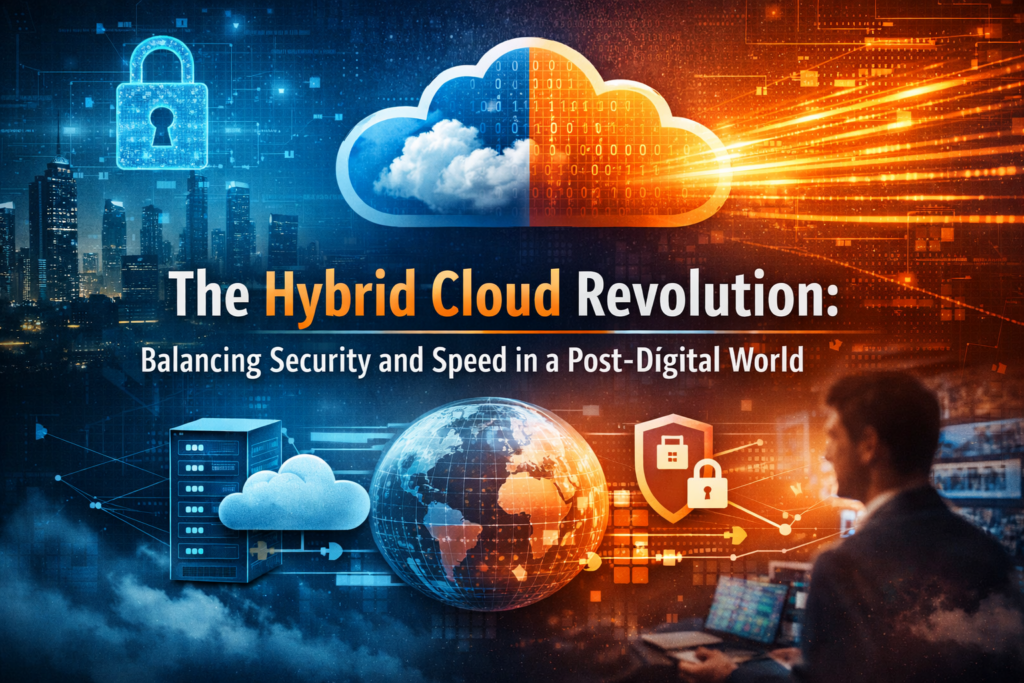
The Central Conflict: Speed vs. Security
Why Speed Matters
Today’s markets move in real time.
Product cycles are shorter.
Customer expectations are instant.
AI systems learn and evolve continuously.
Companies must:
- Deploy new services rapidly
- Scale operations globally
- Integrate AI and data pipelines without friction
Speed is no longer a luxury — it is oxygen.
Why Security Cannot Be Compromised
At the same time, the digital economy is built on trust.
Organizations face:
- Rising cyber threats
- Increasing regulatory pressure
- Growing responsibility over personal and corporate data
A single breach can erase years of brand credibility.
The modern enterprise therefore lives in constant tension:
Move faster — but never break trust.
How Leading Companies Balance Both
The most successful organizations approach hybrid cloud with a clear philosophy:
1. Zero-Trust Architecture
Every user, device, and request is verified — continuously.
2. Intelligent Automation
Security policies, updates, and monitoring are driven by AI to respond instantly to new threats.
3. Data Governance by Design
Sensitive data remains protected in private environments, while non-critical workloads benefit from the public cloud’s speed.
4. Continuous Visibility
Unified dashboards monitor performance, compliance, and risk across all environments in real time.
Security becomes built into the system, not added as an afterthought.

Why Hybrid Cloud Is the Winning Model
Hybrid cloud delivers:
- Agility — faster innovation cycles
- Resilience — reduced downtime and risk
- Cost efficiency — optimized infrastructure spending
- Compliance readiness — localized data control
- AI acceleration — scalable compute for intelligent systems
Most importantly, it allows organizations to evolve continuously — without being trapped by their own infrastructure.
The Post-Digital Business Reality
In the post-digital world:
- Technology is assumed
- Data is the core asset
- Trust is the currency
- Intelligence is the differentiator
Hybrid cloud sits at the center of this ecosystem, enabling businesses to build systems that are not only faster and safer — but smarter.
Conclusion: The New Rule of Competition
The winners of the next decade will not be the fastest companies.
They will not be the most secure companies.
They will be the companies that master both.
Hybrid cloud is not simply an infrastructure model —
It is the foundation of modern leadership in a world where innovation never pauses and trust must never fail.
Frequently Asked Questions (FAQ)
1. What is a Hybrid Cloud in simple terms?
A hybrid cloud is a combination of public cloud, private cloud, and on-premise systems that work together. It allows businesses to enjoy the speed of public cloud services while keeping sensitive data secure in private environments.
2. Why is hybrid cloud important in the post-digital world?
In the post-digital world, digital technology is no longer an advantage — it is a requirement. Hybrid cloud helps organizations stay competitive by offering both speed for innovation and security for trust, which are the two most critical business needs today.
3. How does hybrid cloud improve business performance?
Hybrid cloud improves performance by:
- Reducing system downtime
- Accelerating product launches
- Improving data management
- Enabling AI and analytics at scale
- Ensuring compliance and data protection
4. Is hybrid cloud more secure than public cloud alone?
Yes. Hybrid cloud allows businesses to keep sensitive workloads in private environments while using public cloud for scalable operations. With proper architecture and security policies, hybrid cloud offers stronger control and reduced risk.
5. Can small businesses benefit from hybrid cloud?
Absolutely. Hybrid cloud is not only for large enterprises. Small and medium businesses use hybrid cloud to grow faster, protect customer data, and manage IT costs efficiently.
6. How does hybrid cloud support AI and data analytics?
Hybrid cloud provides the computing power and flexibility needed for AI and big data workloads while keeping confidential data protected. This balance makes it ideal for modern AI-driven operations.
7. What industries benefit the most from hybrid cloud?
Industries such as finance, healthcare, e-commerce, manufacturing, logistics, and education benefit greatly from hybrid cloud due to their need for both speed and high security.
8. Is hybrid cloud the future of business infrastructure?
Yes. Most global organizations are shifting toward hybrid cloud because it offers the most practical, secure, and scalable path for long-term digital growth.
It’s refreshing to see the hybrid cloud approach emphasized as a strategy for business survival rather than just an IT solution. As companies move faster, they can’t afford to overlook security, especially with the growing cyber threats we’re seeing.
You’re absolutely right.
In today’s business environment, hybrid cloud is no longer just a technology choice — it has become a core business survival strategy.
As organizations accelerate innovation and expansion, ignoring security is simply not an option.
With the rapid rise in cyber threats, trust and protection are now as critical to growth as speed and agility.
Hybrid cloud provides that balance, allowing companies to move fast while maintaining strong control, compliance, and resilience.
That balance is what will separate tomorrow’s market leaders from the rest.