
Many organizations today are filled with talented people, powerful tools, and ambitious growth plans. Yet profitability stalls. Growth feels expensive. Customer experience breaks at unexpected points.
The reason is simple, but costly: disconnection.
Disconnected teams, disconnected data, disconnected systems — all quietly draining revenue, speed, and trust.
The Hidden Cost of Disconnected Business Units
Disconnection doesn’t always look like chaos.
In fact, it often looks like busy productivity.
- Marketing generates leads, but sales questions their quality
- Sales closes deals, but operations struggles to deliver what was promised
- Customer support handles complaints without context
- Leadership waits days or weeks for accurate performance data
Each department performs well in isolation — yet the business underperforms as a whole.
The real costs include:
- Slower decision-making
- Higher customer acquisition costs
- Revenue leakage between handoffs
- Poor customer experience
- Burnout caused by repeated rework
Over time, these inefficiencies compound — and competitors with integrated systems move ahead faster and cheaper.

Why Integration Is the Profit Multiplier in 2026
High-performing companies in 2026 share one trait:
their business units operate as one connected growth engine.
Integration means:
- Shared data across marketing, sales, operations, and support
- Unified technology platforms instead of scattered tools
- Aligned KPIs tied to business outcomes, not departmental metrics
- Real-time visibility for leadership
When integration is done right, every action feeds the next.
The result?
- Marketing attracts the right customers
- Sales closes faster with full context
- Operations delivers predictably
- Support builds long-term loyalty
- Leadership makes confident, data-backed decisions
This is why integrated organizations consistently outperform disconnected ones — often achieving up to 3x higher profitability.
Why This Matters More Than Ever in 2026
The business environment in 2026 is unforgiving.
- AI-driven competitors move faster
- Customers expect personalized, seamless experiences
- Margins are under pressure across industries
- Speed and clarity matter more than scale
In this environment, fragmentation is a liability.
Companies that fail to integrate their systems and teams don’t just grow slower — they become invisible to modern customers.
Integration is no longer an IT upgrade.
It’s a leadership decision.

Integration Is Not Just Technology — It’s Strategy
One common mistake organizations make is assuming integration is only about software.
In reality, true integration sits at the intersection of:
- Technology
- Data
- Processes
- People
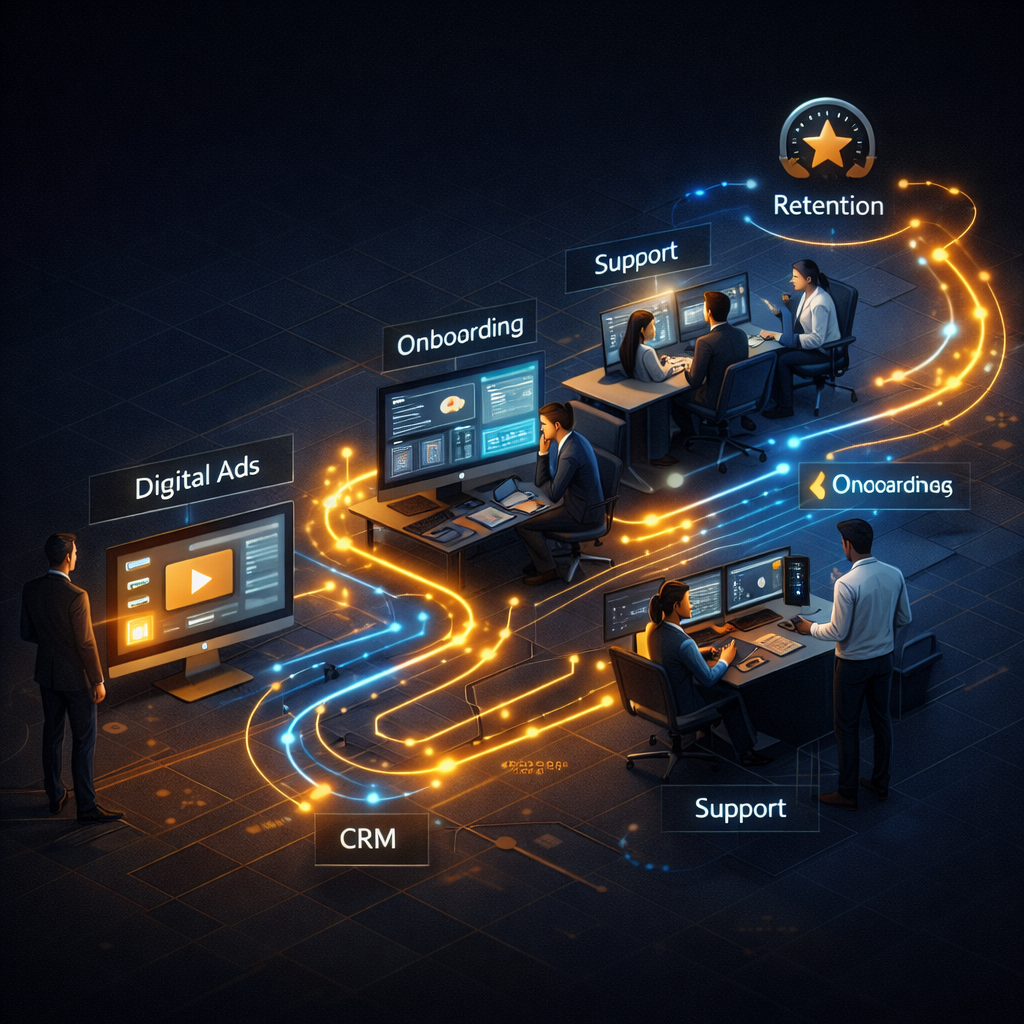
It requires understanding how value flows from first customer touchpoint to long-term retention — and designing systems that support that flow without friction.
This is where execution matters.
How Pulse Analytix Helps Businesses Eliminate Disconnection
At Pulse Analytix, we help organizations move from fragmented operations to fully integrated growth systems.
Our approach is not about adding more tools — it’s about making existing investments work together intelligently.
What We Do Differently
1. Business-First Integration Strategy
We start by understanding how your business makes money — not just how your tech stack looks.
2. Marketing, Sales & Data Alignment
We connect digital marketing, CRM, analytics, and automation so leads, conversions, and insights flow seamlessly.
3. Smart Technology Integration
From CRM and marketing platforms to dashboards and AI tools, we ensure systems communicate in real time.
4. Leadership-Level Visibility
We build data intelligence layers that give decision-makers instant clarity — not delayed reports.
5. Scalable, Future-Ready Architecture
Everything we design is built to scale with AI, automation, and evolving customer expectations.

The Result: One Connected Growth Engine
Clients who partner with Pulse Analytix experience:
- Faster go-to-market execution
- Reduced operational waste
- Higher customer lifetime value
- Stronger internal alignment
- Measurable improvements in profitability
Most importantly, they gain control — over data, decisions, and growth.
Final Thought from the Leadership Desk
In 2026, the question is no longer:
“Do we need digital transformation?”
The real question is:
“Are our business units working together — or working against each other?”
Disconnection is expensive.
Integration is profitable.
And the organizations that understand this today will define their markets tomorrow.
Ready to Build an Integrated, Profitable Business?
Pulse Analytix partners with forward-thinking leaders to design connected systems that drive real results.
The future belongs to integrated businesses — let’s build yours.
Frequently Asked Questions (FAQ)
1. What does “integrated business units” actually mean?
Integrated business units refer to departments such as marketing, sales, operations, and customer support working on shared systems, shared data, and aligned goals. Instead of operating in silos, every team contributes to a single, connected growth process.
2. Why are disconnected business units less profitable?
Disconnected units create inefficiencies like duplicated work, poor handoffs, delayed decisions, and inconsistent customer experiences. These issues increase costs and reduce conversion rates, directly impacting profitability.
3. Is integration only relevant for large enterprises?
No. In fact, small and mid-sized businesses benefit even more from integration because it allows them to scale efficiently without increasing headcount or operational complexity.
4. How does integration improve customer experience?
When systems and teams are connected, customers experience:
- Consistent messaging
- Faster response times
- Personalized interactions
- Fewer errors or misunderstandings
This leads to higher satisfaction, retention, and lifetime value.
5. Does integration require replacing all existing tools?
Not at all. Most integration projects focus on connecting and optimizing existing tools, not replacing them. The goal is to make current investments work together intelligently.
6. How long does it take to see results from integration?
Initial improvements such as better visibility and faster workflows can be seen within weeks. Measurable gains in efficiency, customer experience, and profitability typically follow within a few months, depending on business complexity.
7. How does Pulse Analytix approach business integration differently?
Pulse Analytix focuses on business outcomes first, not just technology. We align systems, data, and processes around revenue growth, customer experience, and leadership clarity.
8. Is this approach future-proof for 2026 and beyond?
Yes. Integrated systems form the foundation for AI, automation, and advanced analytics. Without integration, adopting future technologies becomes fragmented and ineffective.
9. What industries benefit most from integrated business units?
Integration delivers strong results across industries including:
- IT & SaaS
- Real estate
- E-commerce
- Healthcare
- Professional services
- Manufacturing
Any business managing multiple customer touchpoints benefits from integration.
10. How can we get started with Pulse Analytix?
The first step is a strategic assessment to identify disconnects across systems, teams, and data flows. From there, Pulse Analytix designs a clear, scalable integration roadmap tailored to your business goals.